Pages

Thursday, October 30, 2008

Economy shrinks in 3Q, signaling recession


AP WASHINGTON: The economy jolted into reverse during the third quarter as consumers cut back on their spending by the biggest amount in 28 years, the strongest signal yet the country has hurtled into recession. The broadest barometer of the nation's economic health, gross domestic product, shrank at a 0.3 percent annual rate in the July-September quarter, the Commerce Department reported Thursday. It marked the worst showing since the economy contracted at a 1.4 percent pace in the third quarter of 2001, when the nation was suffering through its last recession. The latest GDP reading marked a rapid loss of traction for the economy, which logged growth of 2.8 percent in the second quarter, and is sure to buttress the belief of many economists that the nation is in the throes of a painful downturn.

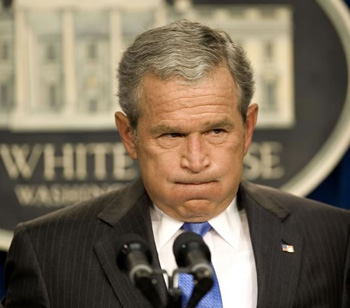
"No question. We're definitely in a recession. That is just a reality," said Brian Bethune, economist at IHS Global Insight. The White House tried to downplay the significance of the numbers, saying they were not unexpected and caused partly by special circumstances such as hurricanes and a Boeing Co. strike.

"While we continue to face serious challenges, the United States remains the best place to do business, and we're positioned to bounce back," White House press secretary Dana Perino said. The deterioration reflected a sharp retrenchment by consumers, whose spending accounts for the largest chunk of national economic activity. Consumers ratcheted back their spending at a 3.1 percent pace in the third quarter, the most since the second quarter of 1980, when the country was in the grip of recession. GDP measures the value of all goods and services produced within the United States and is the broadest barometer of the country's economic health. While the third-quarter's contraction wasn't as deep as the 0.5 percent annualized decline analysts expected, the poor showing underscored the terrible toll of the housing, credit and financial crises. J. Steven Landefeld, director of the Commerce Department's Bureau of Economic Analysis, which puts together the GDP report, didn't use the word "recession" to describe economic conditions but said: "Certainly we are seeing a period of dramatic slowdown."

On Wall Street, however, the smaller-than-expected decline gave some comfort to investors. The Dow Jones industrials were up about 80 points in midday trading. Meanwhile, the Labor Department said Thursday that new claims for jobless benefits for the week ending Oct. 25 stood at a seasonally adjusted 479,000, the same as the previous week and above analysts' estimates of 475,000. Jobless claims above 400,000 are considered a sign of a struggling economy. The grim reports come just days before the nation picks the next president on Nov. 4. Whether Democrat Barack Obama or Republican John McCain wins the White House, the incoming president will inherit a deeply troubled economy and a record-high budget deficit that could cramp his domestic agenda. Many economists believe the economy will continue to contract into next year, which would more than meet a classic definition of recession two straight quarters of shrinking GDP. The National Bureau of Economic Research, the panel of experts that determines when U.S. recessions begin and end, uses a broader definition to determine recessions than two quarters of contracting GDP. That didn't happen in the last recession, in 2001. The NBER takes into account income, employment and other barometers. The finding is usually made well after the fact.

A collapse of the housing market and locked up lending have produced the worst financial crisis to hit the country in more than 70 years. To cushion the fallout, the Fed slashed interest rates on Wednesday by half a percentage point to 1 percent, a level seen only once before in the last half century.Fed Chairman Ben Bernanke has warned that the country's economic weakness could last for some time even if the government's unprecedented $700 billion financial bailout package and other steps do succeed in getting financial and credit markets to operate more normally. Unemployment now at 6.1 percent could hit 8 percent or higher next year. Disappearing jobs, battered nest eggs and retirement accounts, and falling home prices are likely to make consumers retrench even more. Underscoring the strain faced by consumers, the report showed that Americans' disposable income fell at an annual rate of 8.7 percent in the third quarter, the largest quarterly drop on records dating back to 1947.

In the third quarter, consumers cut back on purchases of cars, furniture, household appliances, clothes and other things.They pulled back after the bracing impact of the government's tax rebates disappeared. In addition to consumers, businesses cut back sharply in the third quarter. They cut spending on equipment and software at a 5.5 percent pace, the most since the first quarter of 2002, when the economy was struggling to recover from the 2001 recession. Home builders slashed spending at a 19.1 percent pace, marking the 11th straight quarterly cut back, and fresh evidence of the depth of the housing slump. Slower growth for U.S. exports reflecting less demand from overseas buyers who are coping with their own economic problems also factored into the weak GDP report. Exports grew at a 5.9 percent pace in the third quarter, a sharp deceleration from the second quarter's 12.3 percent growth rate. The U.S. economic downturn in the third quarter was accompanied by higher inflation. An inflation gauge tied to the GDP report showed prices excluding food and energy rose at a 2.9 percent pace, up considerably from the 2.2 percent growth rate in the second quarter. Although the new reading is outside the Fed's comfort zone, Fed officials predict the economy's slowdown will damp inflation pressures in the months ahead. The Fed has made clear that its primary mission at the moment is reviving the economy.

Monday, October 27, 2008

Newspapers see sharp circulation drop of 4.6 pct

By ANICK JESDANUN
(AP) — The nation's daily newspapers, already finding advertising revenue fell sharply because of the weak economy, saw circulation decline more steeply than anticipated in the latest reporting period, an auditing agency said Monday. Average weekday circulation was 38,165,848 in the six-months ending in September, a 4.6 percent decline from 40,022,356 a year earlier at the 507 papers that reported circulation totals in both periods. The drop was only 2.6 percent in the September 2007 period, compared with September 2006. In the six-month period that ended in March 2008, the decline was 3.6 percent over a year earlier, according to circulation figures that newspapers submitted to the Audit Bureau of Circulations. Sunday circulation fell even more, 4.8 percent, to 43,631,646 in the latest period at the 571 papers with comparable totals. The drop was 3.5 percent a year ago and 4.6 percent in the period ending in March. Circulation and advertising have been dropping at newspapers as readers continue to migrate to the Internet. Ad revenue began to decline more steeply this summer as the weak economy prompted advertisers to pull back on spending. The sharper circulation declines appear to be a response to that, said Rick Edmonds, media analyst at the journalism think tank Poynter Institute.

"Times are tough, and they are looking at everything that's in their expense base," he said. "Building new subscribers is an expensive proposition." Some newspapers have purposely let some sales slide to focus on those readers who are coveted by advertisers and exclude those in outlying areas that are more expensive to reach. Circulation could drop even faster as regular readers, in a tight economy, decide they no longer need their printed newspapers, Edmonds warned. Many papers have offset circulation declines with price increases, though papers risk losing readers if they raise prices too much. In a sign of hope, the Newspaper Association of America said last week that usage of newspaper Web sites grew nearly 16 percent in the third quarter, compared with last year, to an average of more than 68 million monthly unique visitors. But online ad sales haven't increased fast enough to offset the declines in print, which still makes up the bulk of a paper's revenue. USA Today remains the nation's top-selling newspaper, with average daily circulation of 2,293,310, just 173 more than last year. The No. 2 daily, The Wall Street Journal, also reported flat circulation — up just 117 copies to 2,011,999.

The New York Times saw circulation decline 3.6 percent to 1,000,665, while the Los Angeles Times had a 5.2 percent drop to 739,147. The other papers in the top 25 also saw circulation drops of from 1.9 percent at The Washington Post to 13.6 percent at The Atlanta Journal-Constitution. The New York Times remains the top paper on Sundays, when USA Today and the Journal do not publish, with a circulation of 1,438,585, down 4.1 percent. The Los Angeles Times follows at 1,055,076, down 5.1 percent, and the Post at 866,057, a decrease of 3.2 percent. Among the top 25, only the St. Louis Post-Dispatch and the St. Petersburg (Fla.) Times reported Sunday gains, of 0.8 percent and 0.1 percent, respectively. Despite the industrywide decline in circulation, five papers outside the top 25 reported gains of at least 5 percent, led by the Wisconsin State Journal of Madison, where circulation rose 10.6 percent to 97,012. The other gainers are The Macomb Daily of Mount Clemens, Mich., The Daily Sun of The Villages, Fla., The Times of Trenton, N.J., and the Citizen Tribune of Morristown, Tenn.

Wednesday, October 22, 2008

Wells Fargo Chairman Prefers U.S. Plan to Buy Stakes

(Bloomberg) -- Wells Fargo & Co. Chairman Richard Kovacevich said the U.S. Treasury's intention to buy stock in banks provides a better stimulus to escape the financial crisis than an earlier plan to purchase soured mortgage-related assets.

``Direct capital injections versus buying loans is a far more preferable way'' to help companies already facing credit losses, Kovacevich, 64, said yesterday at an event hosted by San Francisco's Commonwealth Club. ``It's an important tool to get the financial system back into the money business again.'' Wells Fargo, which agreed to buy Wachovia Corp. for about $14 billion this month, is one of nine large lenders slated to receive cash infusions as part of the government's plan to spend $700 billion unfreezing credit markets. Wells Fargo, based in San Francisco, will get $25 billion. JPMorgan Chase & Co., Citigroup Inc. and Goldman Sachs Group Inc. are among the others that will receive the cash.

U.S. Treasury Secretary Henry Paulson last week urged banks to ``deploy'' the money in loans. He was forced to change his strategy after the initial plan to buy distressed assets caused banks to hoard cash and failed to halt a slide in the stock market. Kovacevich declined to say if he initially opposed Paulson's plan as the New York Times reported. Wells Fargo dropped 99 cents, or 3 percent, to $31.65 at 10:04 a.m. in New York Stock Exchange composite trading. The shares gained 8.1 percent this year through yesterday, the biggest advance in the 24-comopany KBW Bank Index. Wachovia fell 17 cents to $5.92, adding to its 84 percent decline this year.

He's Seen Worse

Kovacevich said the current economic crisis isn't the worst he's seen, and the U.S. government's may help end the credit freeze ``reasonably soon.''

``Our customers, except those in residential home lending or autos, are doing quite well,'' he said. ``By far, the worst economic crisis of my career was in the 1980s.'' The Wachovia deal, orchestrated by Kovacevich, marks an eastward expansion and strategic shift for Wells Fargo, which maintained a profit during the financial crisis by avoiding riskier loans. Wachovia's mortgage portfolio includes an estimated $74 billion in future losses. The Wells Fargo-Wachovia deal will create the biggest U.S. bank network, with 6,675 branches. The Federal Reserve said yesterday that Wells Fargo agreed to reduce its deposit base to comply with U.S. bank-merger law should the combined company control more than 10 percent of deposits nationwide.

Wachovia reported its third straight quarterly loss today, hurt by crumbling mortgage markets and writedowns on securities backed by real estate. The loss for the three months ended Sept. 30 was $23.9 billion, or $11.18 a share, compared with net income of $1.6 billion, or 85 cents, in the same period a year earlier, the Charlotte, North Carolina-based company said in a statement. The Wachovia deal would be Wells Fargo's biggest acquisition since Norwest Corp. purchased the old Wells Fargo 10 years ago and adopted the name. Kovacevich was chief operating officer at Minneapolis-based Norwest in the 1980s when current Wells Fargo Chief Executive Officer John Stumpf, 55, was running the auto-dealer business and working on commercial loans. Kovacevich was promoted to CEO of Norwest in 1993 and stepped down in June 2007 to make way for the promotion of Stumpf, who has been with the company for 26 years.

Let 'Em Ride


I haven't been playing much online poker since my party poker days at college but I've recently been getting into some of the new casino sites that offer table games. A friend of mine recommended a new German casino www.casino.de that is absolutely fabulous. They've got a great blackjack game and my favorite craps. Craps is possibly the most fun table game in casinos and although it's dangerous, can provide hours of fun online. There's nothing like being on a roll in craps. I remember being at the Luxor a few years ago and turning my gas money (that's all I had left after getting killed in blackjack) into a grand on the last night in the casino. The shooter at the table didn't crap out for 2 hours! I'll probably be gambling less after losing a lot in the markets this month but there will always be a place in my heart for that Las Vegas action that you can now get online. This casino is great because not only can I enjoy the gaming, I can also brush up on my German which I've used less and less since my days in Berlin. I'd be wary of spending too much on gambling, but the game play is great and if you can't make it to Vegas or Atlantic City (and you speak German) check our their site for good times. Good Luck!

Thursday, September 25, 2008

Deal close on $700 billion financial bailout plan

By JULIE HIRSCHFELD DAVIS

WASHINGTON (AP) - President Bush is bringing presidential candidates Barack Obama and John McCain into negotiations on a $700 billion rescue of Wall Street as Democrats and Republicans near agreement on a bailout plan with more protections for taxpayers and new help for distressed homeowners. Senior lawmakers and Bush administration officials have cleared away key obstacles to a deal on the unprecedented rescue, agreeing to include widely supported limits on pay packages for executives whose companies benefit. They're still wrangling over major elements, including how to phase in the eye-popping cost - a measure demanded by Democrats and some Republicans who want stronger congressional control over the bailout - without spooking markets. A plan to let the government take an ownership stake in troubled companies as part of the rescue, rather than just buying bad debt, also was under intense negotiation. A bipartisan meeting was set for Thursday to begin drafting a compromise, which top Democrats said they hoped could pass within days.

The core of the plan envisions the government buying up sour assets of shaky financial firms in a bid to keep them from going under and to stave off a potentially severe recession. Bush acknowledged in a prime-time television address Wednesday night that the bailout would be a "tough vote" for lawmakers. But he said failing to approve it would risk dire consequences for the economy and most Americans.

"Without immediate action by Congress, America could slip into a financial panic, and a distressing scenario would unfold," Bush said as he worked to resurrect the unpopular bailout package. "Our entire economy is in danger." Bush's warning came soon after he invited Obama and McCain, one of whom will inherit the economic mess in four months, as well as key congressional leaders to a White House meeting Thursday to work on a compromise. With the administration's original proposal considered dead in Congress, House leaders said they were making progress toward revised legislation that could be approved. Rep. Barney Frank, D-Mass., who has led negotiations with Treasury Secretary Henry Paulson on the package, said that given the progress of the talks, the White House meeting was a distraction.

"We're going to have to interrupt a negotiating session tomorrow between the Democrats and Republicans on a bill where I think we are getting pretty close, and troop down to the White House for their photo op," said Frank, the House Financial Services Committee chairman. "I wish they'd checked with us." Paulson and Federal Reserve Chairman Ben Bernanke have been crisscrossing Capitol Hill in recent days, shuttling between public hearings on the proposal and private meetings with lawmakers, to sell the proposal. Obama and McCain are calling for a bipartisan effort to deal with the crisis, little more than five weeks before national elections in which the economy has emerged as the dominant theme.

"The plan that has been submitted to Congress by the Bush administration is flawed, but the effort to protect the American economy must not fail," they said in a joint statement Wednesday night. "This is a time to rise above politics for the good of the country. We cannot risk an economic catastrophe." Presidential politics intruded, nonetheless, when McCain said earlier Wednesday he intended to return to Washington and was asking Obama to agree to delay their first debate, scheduled for Friday, to deal with the meltdown. Obama said the debate should go ahead. Lawmakers in both parties have objected strenuously to the rescue plan over the past two days, Republicans complaining about federal intervention in private business and Democrats pressing to tack on more conditions and help for beleaguered homeowners. But many in both parties said they were open to legislation, although on different terms than the White House has proposed. Some partisan sticking points remain. Democrats are pushing to allow bankruptcy judges to rewrite mortgages to ease the burden on consumers who are facing foreclosure - a nonstarter for Republicans.

Democrats acknowledge privately that the provision will almost certainly be dropped in the interest of a bipartisan deal. Obama told reporters it's "probably something that we shouldn't try to do in this piece of legislation." Democrats also want any potential proceeds the government reaps from the bailout to go to a fund designed to pay for housing for poor families. Many Republicans oppose the very existence of the fund, which they say is a backdoor means of funneling money to liberal political groups. Democratic demands that Congress be given greater authority over the bailout and that the government be required to help homeowners renegotiate their mortgages so they have lower monthly payments already have been accepted in principle. Under the bailout bill, which will let the government buy huge amounts of toxic mortgage-related assets, "we're now the biggest mortgage holder in town, and we can do serious foreclosure avoidance," Frank said.

Bush Warns "Entire Economy Is In Danger"


Media reports are casting President Bush's televised address last night as both a warning to the nation on the severity of the financial crisis and an attempt to push Congress into passing his proposed bailout. A number of the stories remark on Bush's stark warnings about the health of the economy. Roll Call, for example, says Bush "sketched a frightening view of the economic danger," and used "unusually blunt and even dramatic language." The New York Times reports Bush told the country that "'a long and painful recession' could occur if Congress does not act quickly." Like many other media outlets this morning, the Times quotes the President saying, "Our entire economy is in danger." Bush's speech highlighted "a growing sense of urgency on the part of the administration that Congress must act to avert a far-reaching economic collapse." USA Today notes the President also said, "Without immediate action by Congress, America could slip into a financial panic. ... More banks could fail, including some in your community." He also "warned that inaction could cause millions of layoffs, bank failures, business closures, lost retirement savings, more foreclosures, a further drying up of credit." McClatchy, Los Angeles Times and Washington Post run similar reports.

The speech is also seen as a response to critics who accused the President of not having played a lead role in the government's efforts to defuse the crisis. USA Today reports, for example, that Bush faced "criticism from some Democrats for being AWOL in the debate," and the Wall Street Journal says that "until now," the President had "relied largely on Treasury Secretary Henry Paulson -- a former Goldman Sachs CEO -- and Federal Reserve Chairman Ben Bernanke to make the case for the plan," but "Republican support has been so soft that Democrats worried they would have to take on most of the responsibility -- and political risk -- for passing the package." And "to spread that risk, Democrats on Tuesday called on Mr. Bush to address the nation."

The Politico describes Paulson as "the captain of a crowded lifeboat" who "struggled to stay afloat in Congress Wednesday, battling the waves crashing in on his Wall Street rescue plan." With his speech, Bush was "lending a hand" and taking "back the helm long enough Wednesday night to deliver a nationally televised address," but "to the surprise of some in his own administration, Bush spent precious political capital by using the speech to try to help McCain by bringing him into what have been delicate negotiations with Congress."

McCain, Obama To Attend White House Talks Today The AP notes Bush "spoke just after inviting Democrat Sen. Barack Obama and Republican Sen. John McCain, one of whom will inherit the mess in four months, and key congressional leaders to an extraordinary White House meeting Thursday to hammer out a compromise." In his speech, the President "explicitly endorsed several of the changes that have been demanded in recent days from the right and left. But he warned that he would draw the line at regulations he determined would hamper economic growth." Another AP story and a report in the Los Angeles Times, among other media stories, note both Obama and McCain have said they will attend the meeting.

Wednesday, September 10, 2008

Lehman: Too big to fail?

By Paul R. La Monica, CNNMoney.com editor

NEW YORK (CNNMoney.com) -- Lehman Brothers has finally announced a path to raising capital. But after Tuesday's 45% plunge in its stock price, it's unclear if Wall Street will let chief executive officer Richard Fuld carry out the plan. Lehman's (LEH, Fortune 500) stock was down about 2% late Wednesday morning after the company said it would slash its dividend, look for a buyer of the majority of its Neuberger Berman investment management unit and spin off part of its commercial real estate business. Shares are trading at their lowest point in 10 years, having plummeted nearly 90% so far this year. And by the way, the company lost $3.9 billion in the third quarter. So now, the natural question that needs to be asked is this: On the heels of the Treasury Department's takeover of mortgage giants Fannie Mae (FNM, Fortune 500) and Freddie Mac (FRE, Fortune 500), does the government now have to step in and bailout Lehman as well. Unfortunately, it may have no choice.

Talkback: Do you think Lehman should be allowed to fail or does it need to be bailed out?

The Federal Reserve set a dangerous precedent in March when it helped engineer the takeover of Bear Stearns by JPMorgan Chase (JPM, Fortune 500) by agreeing to guarantee $29 billion in potential losses. Since then, several Fed members, most notably chief Ben Bernanke, have gone out of their way to defend the action, arguing that Bear Stearns simply was too big to fail. The repercussions of allowing Bear to collapse could have been catastrophic. So if Bear was determined to be too big to fail, isn't it likely the Fed would think Lehman is as well?

Probably. That's because Lehman, the fourth-largest investment bank, is bigger than Bear, which was the fifth-largest at the time it nearly imploded. What's more, Lehman, a bond-trading powerhouse, is even a bigger player in the mortgage-backed securities market than Bear was. So the Fed could easily argue that letting Lehman go under could create even more chaos in the already volatile credit markets. Yes, Fuld wants to keep the bank independent by taking a piecemeal approach to breaking up the company. But the market may not let him do so. And until Lehman actually announces that it has, in fact, raised a substantial amount of capital, it's likely that there will be continued pressure on the stock. If Lehman's stock falls further, it's reasonable to think that some financial institution would take a gamble on buying the company, especially if it could get Lehman through a "takeunder" just as JPMorgan did with Bear.

Some analysts have tossed out investment manager BlackRock (BLK, Fortune 500), British bank HSBC (HBC) and private equity firm Blackstone (BX) as potential bidders. But why would any of them agree to take on all the risk without some assurance from the Fed? After all, that's exactly what JPMorgan got in the Bear deal. Don't get me wrong. I don't like the notion of big Wall Street firms getting saved after making irresponsible, reckless decisions. In what's supposed to be a free market, companies should be allowed to fail. But the Fed has already opened Pandora's box. It's too late now to say that Lehman should be left to wither away to nothing while Bear was allowed to escape that fate. To be sure, if one of the three aforementioned firms were to try and buy Lehman and wanted the Fed's help, this would be more complicated than the JPMorgan takeover. BlackRock and Blackstone aren't banks. And HSBC is not a U.S.-headquartered institution.

Still, Bernanke and Fed vice chairman Tim Geithner have demonstrated a remarkable willingness to be flexible and creative in dealing with the credit crunch. So if they wanted to help someone buy Lehman, one would think they would find a way to get it done. Like it or not, the age of the bailout is in full swing. To top of page